Choose Household Sewage Elevator Common Sense
Leave a message
As we all know, sewage elevator has been widely used, but in everyone's impression may be considered to be factory sewage elevator, but in fact, household sewage elevator is also getting more and more people's favor. Therefore, we need to explain to you the common sense of choosing a household sewage elevator.
First, to choose the installation of household sewage elevator.
At present, there are two ways to install household sewage lifters. One is the ground installation, the other is the underground installation, the choice of what kind of installation depends on the drainage of the family toilet, at present, the family toilet flushing is divided into the lower drainage type and the rear drainage type, and the rear drainage type toilet (also known as the wall toilet) is the most widely used, at present few people choose the lower drainage type toilet. The SFA sewage elevator is installed on the ground. In this way, there is no need to redecorate when adding the drain, and the installation workload is small.
Second, the choice of household sewage elevator lifting drainage.
At present, there are two drainage methods of sewage elevator: backwash type and reamer type.
The first backwash type household sewage elevator has a debris separator inside. This kind of sewage elevator is mostly stainless steel, stainless steel welding material sewage elevator solder joint after a long time soaking and pump work on the box vibration process is easy to open welding, and this kind of sewage elevator are underground installation.
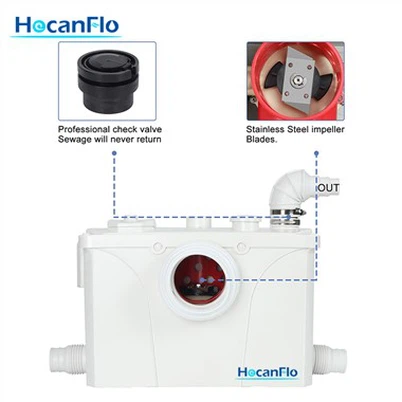
The second kind of reamer type household sewage elevator has a reamer inside, stainless steel reamer high-speed rotation quickly break debris, reamer is equipped with a separator outside, to ensure that the debris is broken and lifted to the municipal pipe network. This drainage method completely eliminates the problem of debris blockage.
Third, the detection device of household sewage elevator. At present, there are three kinds of liquid level detection devices for sewage hoist. The first is pressure-sensitive. The sewage elevator in this way has a rubber pressure sensor and a micro switch to control the start and stop of the pump. The operation is very stable. So SFA sewage elevator adopts this sensor detection device. One is the electrode detection device. There are two high and low electrodes in the sewage hoist, which are used to detect the high and low water level to control the start and stop of the pump. This mode of operation is not stable, because the sewage in the tank is viscous and the environment is harsh, resulting in the electrode reaction is not sensitive, often lead to sewage overflow.
Fourth, the choice of toilet seat.
The wall drain (or rear drain) type sewage elevator should be selected for the ground installation of sewage elevator. The toilet drain outlet is DN100 caliber, and the wall drain type sewage elevator inlet is also DN100 caliber, which is just connected.
Underground installation of sewage elevator to choose the drainage sewage elevator.
Fifth, the model selection of household sewage elevator.
(1) Head selection. The family basement is generally a negative layer underground, so the lifting height of the family sewage elevator is enough for about 3 meters.
(2) Traffic selection. The displacement of common sanitary appliances is as follows:
Toilet (siphon type toilet bottom tank) 1.00 L/s
Urinal (self-closed flush valve) 0.10L /s
Washing basin 0.33 L/s
Wash basin 0.25 L/s
Bath 1.00 L/s
Shower 0.15 L/s
Washing machine 0.50 L/s