What is the hydraulic efficiency of a 300w Macerator Pump?
Leave a message

As a supplier of 300w Macerator Pumps, I often get asked about the hydraulic efficiency of these pumps. Hydraulic efficiency is a crucial factor when it comes to the performance and cost - effectiveness of a macerator pump. In this blog, I'll delve into what hydraulic efficiency means for a 300w Macerator Pump, how it is measured, and what factors can affect it.
Understanding Hydraulic Efficiency
Hydraulic efficiency is a measure of how well a pump can convert the input power (in this case, the 300w of electrical power) into useful hydraulic power. Useful hydraulic power is the power that the pump uses to move the fluid (usually sewage or wastewater) from one place to another. It is calculated by the formula:
[ \text{Hydraulic Power} = \text{Flow Rate} \times \text{Head} \times \text{Fluid Density} \times \text{Gravitational Acceleration} ]
The hydraulic efficiency ((\eta_h)) of a pump is then given by the ratio of the hydraulic power ((P_h)) to the input power ((P_{in})):
[ \eta_h=\frac{P_h}{P_{in}} \times 100% ]
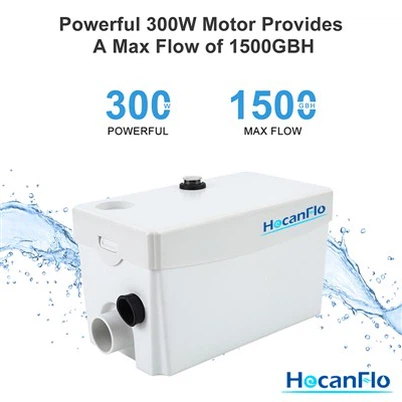
For a 300w Macerator Pump, the input power (P_{in} = 300) watts. A higher hydraulic efficiency means that more of the 300w of electrical power is being used to move the fluid, and less is being wasted as heat or in other non - useful forms of energy.
Measuring Hydraulic Efficiency
To measure the hydraulic efficiency of a 300w Macerator Pump, we need to measure the flow rate and the head. The flow rate is the volume of fluid that the pump can move per unit of time, usually measured in liters per minute (L/min) or cubic meters per hour ((m^3/h)). The head is the height that the pump can lift the fluid, measured in meters.
We can use flow meters and pressure gauges to measure the flow rate and the head respectively. Once we have these values, we can calculate the hydraulic power using the formula mentioned above. Then, by dividing the hydraulic power by the input power (300w) and multiplying by 100%, we get the hydraulic efficiency of the pump.
Factors Affecting Hydraulic Efficiency
Pump Design
The design of the 300w Macerator Pump plays a significant role in its hydraulic efficiency. The impeller design, for example, can greatly affect how well the pump can transfer energy to the fluid. A well - designed impeller will have a shape and size that allows it to efficiently capture the fluid and move it through the pump.
The internal passages of the pump also need to be smooth and properly sized. If the passages are too narrow, they can cause excessive friction, which reduces the hydraulic efficiency. On the other hand, if they are too wide, the fluid may not be properly directed, also leading to a decrease in efficiency.
Fluid Properties
The properties of the fluid being pumped can also have an impact on the hydraulic efficiency. Sewage and wastewater, which are commonly pumped by macerator pumps, can have varying viscosities and contain solid particles. Higher viscosity fluids require more energy to move, which can reduce the hydraulic efficiency.
Solid particles in the fluid can also cause wear and tear on the pump components, such as the impeller and the seals. This wear can lead to leaks and a decrease in the pump's ability to transfer energy to the fluid, thereby reducing the hydraulic efficiency.
Operating Conditions
The operating conditions of the 300w Macerator Pump can affect its hydraulic efficiency. If the pump is operating at a flow rate or head that is far from its design point, its efficiency will decrease. For example, if the pump is designed to operate at a certain flow rate and head, but is forced to operate at a much lower flow rate, it may experience cavitation.


Cavitation is a phenomenon where vapor bubbles form in the fluid due to low pressure. These bubbles can collapse violently, causing damage to the pump components and reducing the hydraulic efficiency.
Importance of Hydraulic Efficiency
The hydraulic efficiency of a 300w Macerator Pump is important for several reasons. Firstly, a more efficient pump will consume less electrical power for the same amount of fluid movement. This means lower energy costs for the user over the lifetime of the pump.
Secondly, a pump with high hydraulic efficiency is less likely to overheat. Overheating can cause damage to the pump motor and other components, leading to costly repairs and replacements.
Finally, a high - efficiency pump is better for the environment. By consuming less energy, it reduces the carbon footprint associated with its operation.
Our 300w Macerator Pumps
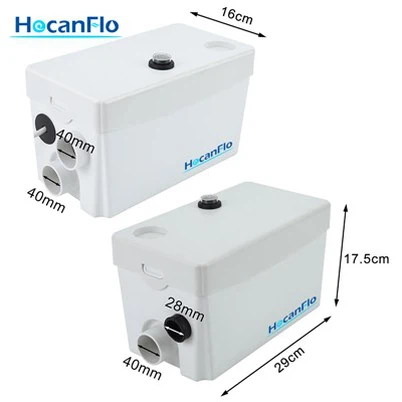
As a supplier of 300w Macerator Pumps, we take great care in designing and manufacturing our pumps to ensure high hydraulic efficiency. Our pumps are equipped with well - designed impellers and smooth internal passages to minimize friction and maximize energy transfer.
We also conduct rigorous testing on our pumps to ensure that they perform well under a variety of operating conditions. Our 300w Sewage Macerator Pump For Basement is specifically designed to handle the challenges of pumping sewage from basements, with high hydraulic efficiency to keep energy costs low.
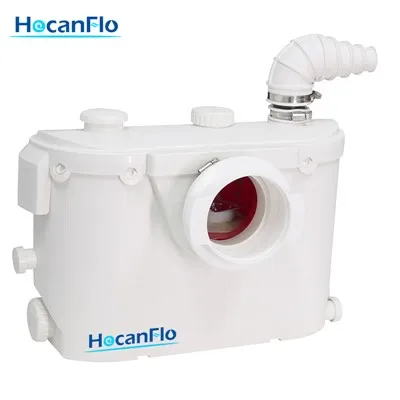
Our Macerator Pump For House is suitable for residential applications, providing reliable and efficient wastewater pumping. And our Wash Basin Macerator Pump is designed to handle the relatively low - volume but continuous flow of wastewater from wash basins, with optimized hydraulic efficiency.
Contact Us for Procurement
If you are interested in our 300w Macerator Pumps and would like to discuss procurement, we welcome you to reach out. We can provide you with detailed information about the hydraulic efficiency and other performance parameters of our pumps. Our team of experts is ready to assist you in choosing the right pump for your specific needs.
References
- Pump Handbook, Karassik, I. J., Messina, J. P., Cooper, P. E., & Heald, C. C.
- Fluid Mechanics, Frank M. White