What is the speed of the motor of a 300w sewage pump?
Leave a message

As a supplier of 300w sewage pumps, I often encounter inquiries from customers about the speed of the motor in these pumps. Understanding the motor speed is crucial as it directly impacts the pump's performance, efficiency, and overall suitability for various sewage - handling applications.
Factors Affecting the Motor Speed of a 300w Sewage Pump
The speed of the motor in a 300w sewage pump is influenced by several factors. First and foremost is the design and construction of the motor itself. Motors can be designed with different numbers of poles, and this has a significant effect on the synchronous speed. The synchronous speed ($N_s$) of an AC motor is given by the formula $N_s=\frac{120f}{P}$, where $f$ is the frequency of the power supply (usually 50Hz or 60Hz in most regions) and $P$ is the number of poles in the motor.
For a 50Hz power supply, a 2 - pole motor will have a synchronous speed of $N_s=\frac{120\times50}{2}=3000$ RPM (revolutions per minute), while a 4 - pole motor will have a synchronous speed of $N_s=\frac{120\times50}{4}=1500$ RPM. In practice, the actual operating speed of the motor will be slightly less than the synchronous speed due to slip. Slip is the difference between the synchronous speed and the actual speed of the motor and is caused by factors such as load and losses in the motor.
The load on the pump also plays a vital role in determining the motor speed. When a sewage pump is operating, it has to overcome the resistance of the sewage being pumped, which includes factors like the viscosity of the sewage, the height to which the sewage needs to be pumped (head), and the length and diameter of the piping system. As the load increases, the motor speed may decrease slightly as the motor has to work harder to maintain the pumping action.
Another factor is the type of motor control used. Some 300w sewage pumps may be equipped with variable - speed drives (VSDs). A VSD allows the motor speed to be adjusted according to the requirements of the pumping process. For example, during periods of low sewage flow, the motor speed can be reduced to save energy, while during peak flow periods, the speed can be increased to ensure adequate pumping capacity.
Typical Motor Speeds for 300w Sewage Pumps
In most common 300w sewage pumps, the motor speeds typically range from around 1400 RPM to 2800 RPM. Pumps with lower motor speeds (around 1400 - 1500 RPM) are often used in applications where a more gentle pumping action is required, or where the sewage contains large solids that could be damaged by high - speed impellers. These pumps are generally more suitable for handling thick or viscous sewage as the lower speed reduces the risk of clogging.
On the other hand, pumps with higher motor speeds (around 2800 RPM) are used in applications where a higher flow rate is needed. The higher speed of the impeller can generate more force, allowing the pump to move sewage more quickly through the system. However, these pumps may be more prone to wear and tear, especially if the sewage contains abrasive particles.
Importance of Motor Speed in Sewage Pump Performance
The motor speed has a direct impact on the pump's flow rate and head. Flow rate refers to the volume of sewage that the pump can move per unit of time, usually measured in liters per minute or gallons per minute. As the motor speed increases, the impeller rotates faster, which generally leads to an increase in the flow rate. However, this relationship is not always linear, as other factors such as the pump design and the load also come into play.
The head of a pump is the height to which the pump can lift the sewage. A higher motor speed can help to increase the head, as the faster - rotating impeller can generate more pressure. But again, there are limits to this, and excessive speed may not always result in a proportional increase in head, especially if the pump is operating near its maximum capacity.
In addition to flow rate and head, motor speed also affects the energy efficiency of the pump. Running a pump at an inappropriate speed can lead to increased energy consumption. For example, if a pump is running at a much higher speed than necessary for a given application, it will consume more electricity without providing a corresponding increase in performance. Therefore, it is essential to select a pump with the appropriate motor speed for the specific sewage - handling requirements.
Our 300w Sewage Pump Offerings
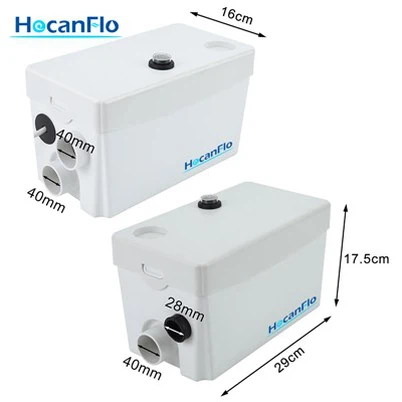
At our company, we offer a range of 300w sewage pumps with different motor speeds to meet the diverse needs of our customers. Our Basement Sewage Macerator Pump is designed for use in basements and other low - lying areas where sewage needs to be pumped to a higher level. This pump typically has a motor speed of around 1400 RPM, which provides a gentle yet effective pumping action, reducing the risk of clogging with solid waste.
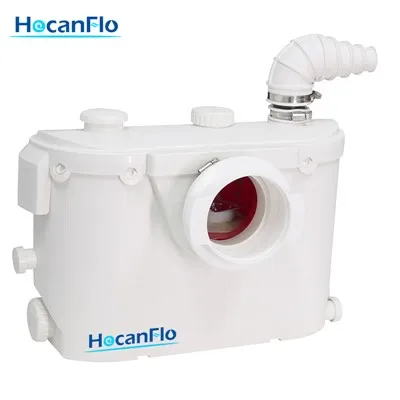
Our Macerator Sewerage Sewage Pump is suitable for handling more complex sewage systems. It can be equipped with a variable - speed drive, allowing the motor speed to be adjusted according to the flow rate and load conditions. This pump offers high efficiency and flexibility, making it a popular choice for commercial and industrial applications.


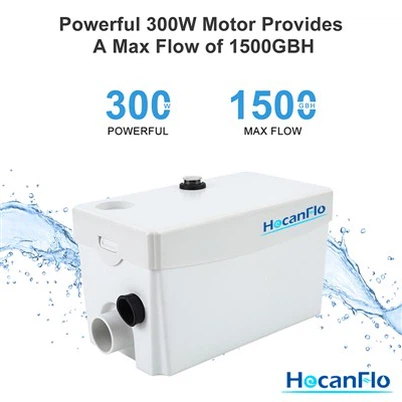
The 300w Sewage Macerator Pump is a versatile option that combines the benefits of a macerating function with a reliable motor. With a motor speed that can be optimized for different applications, this pump can handle a wide range of sewage types, from domestic waste to light industrial effluent.
Contact Us for Your Sewage Pump Needs
If you are in the market for a 300w sewage pump, we encourage you to contact us for more information. Our team of experts can help you select the right pump with the appropriate motor speed for your specific application. We understand that every sewage - handling situation is unique, and we are committed to providing you with the best - suited solution. Whether you need a pump for a small residential basement or a large commercial facility, we have the expertise and products to meet your requirements. Reach out to us to start a discussion about your sewage pump needs and explore the possibilities of our high - quality 300w sewage pumps.
References
- "Pump Handbook" by Igor J. Karassik et al.
- "Electric Motors and Drives: Fundamentals, Types, and Applications" by Austin Hughes.